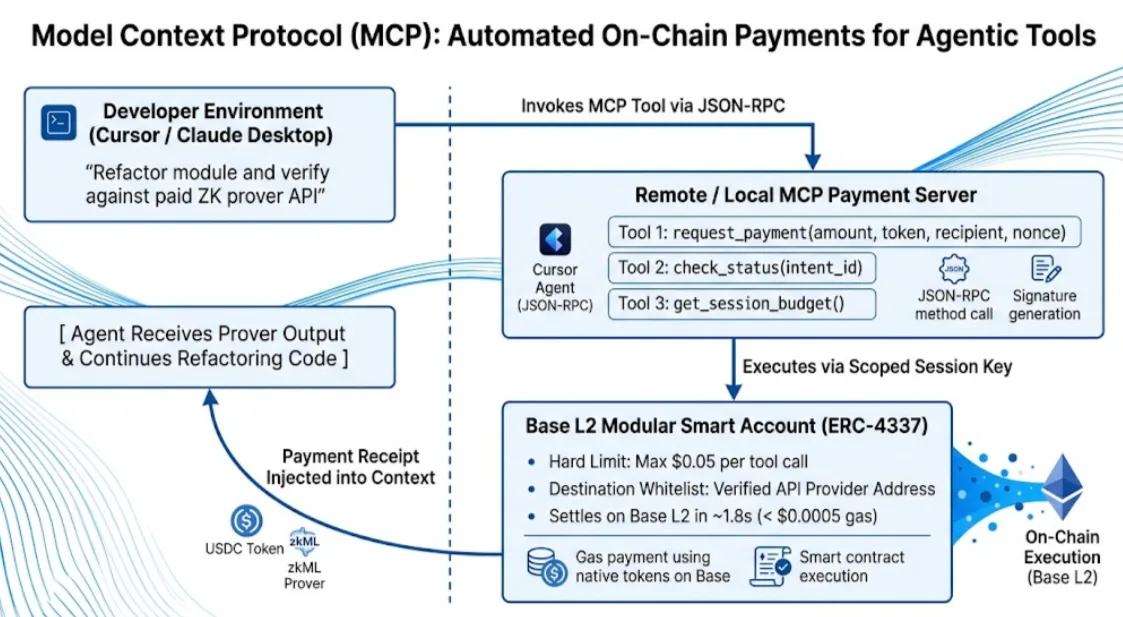
Yesterday, we analyzed how native HTTP 402 status code negotiation enables machines to detect and settle API paywalls per request. Today, we bridge that raw transport protocol into the primary developer environments where modern AI agents actually live and run: AI-assisted IDEs, local agent runtimes, and LLM orchestration frameworks.
In 2026, developers routinely orchestrate fleets of agents inside Cursor, Windsurf, Claude Desktop, and LangChain. These agents refactor repositories, run unit tests, and provision cloud resources. However, as soon as an agent needs to access a paid third-party tool—such as pulling a live financial dataset, running a zero-knowledge vulnerability proof, or deploying a container to a paid decentralized edge cluster—the workflow breaks. The agent hits a paywall, halts execution, and forces a human developer to open a browser, locate an API key, enter a credit card, and pre-fund credits.
To remove this bottleneck, the modern agentic stack implements Standardized Model Context Protocol (MCP) Payment Tooling.
The MCP payment integration operates across three foundational primitives:
1. Standardized Tool Schemas (requestpayment & checkstatus):
Rather than hardcoding bespoke wallet interaction scripts for every individual agent, payment capabilities are exposed as standardized tools conforming to Anthropic's open Model Context Protocol. The agent runtime simply sees clean functional interface.
2. Context-Injected Autonomous Settlement:
When an external service requires payment, the LLM autonomously invokes requestpayment. The MCP server coordinates with the agent's scoped session key, submits the transaction to Base L2, monitors the pre-confirmation event stream, and returns the transaction receipt hash directly into the model's active reasoning context—all without human interruption.
3. Strict Sandboxed Execution Boundaries:
Connecting an agent runtime to a financial account is an extreme risk without boundaries. The MCP server operates as an unprivileged client strictly restricted by smart account session keys. If an agent attempts to call requestpayment with an address outside its approved merchant whitelist or exceeds its hourly spending envelope, the execution is blocked at the smart contract validation layer.
By standardizing payment primitives into the Model Context Protocol, autonomous developer agents evolve from passive text generators into self-sufficient software engineers capable of funding their own tooling.