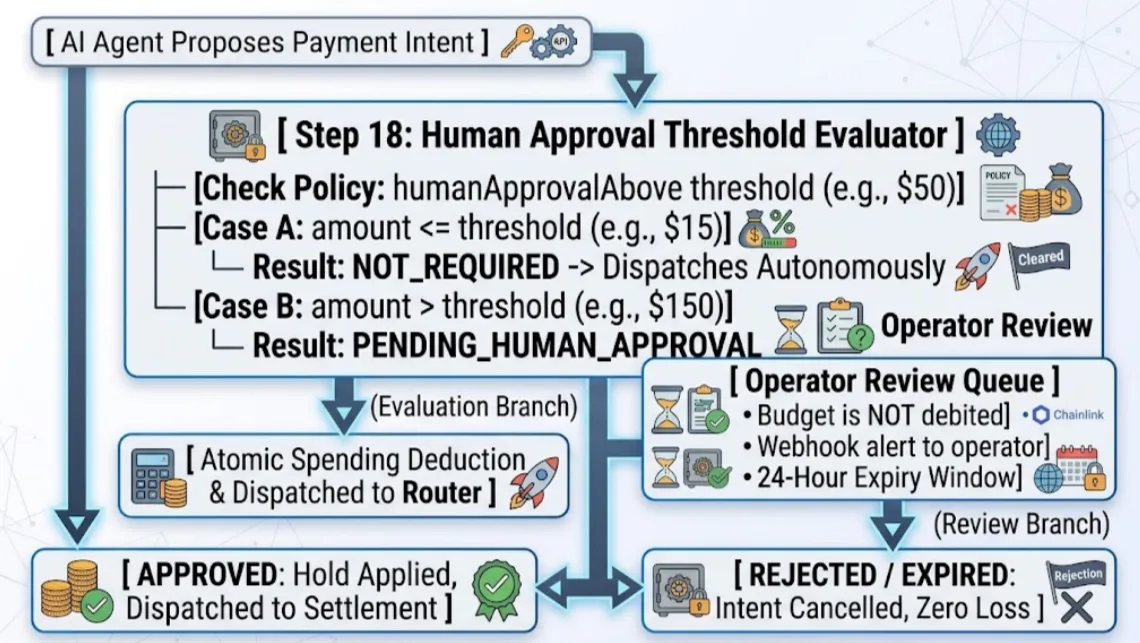
Autonomous AI agents are exceptional at handling routine, programmatic micro-operations: paying $0.002 for an API compute call, settling a $0.05 storage pin, or renewing a routine sub-dollar subscription. In these low-risk execution zones, requiring human authorization for every single transaction destroys autonomous machine loops.
However, full autonomy becomes an unacceptable risk when transaction values escalate. If an agent suddenly decides to purchase an annual enterprise cluster node for $2,500 or execute a high-slippage bulk token conversion, allowing the transaction to execute without human oversight can lead to catastrophic capital loss. Conversely, hard-failing the transaction outright breaks operational continuity when the purchase might actually be legitimate.
The architectural solution is a Human-in-the-Loop (HITL) Threshold Gate governed by an explicit, asynchronous state machine.
A production-grade human approval architecture implements three critical operational guarantees:
1.Deterministic State Machine Enforcement:
Transactions entering the approval pipeline transition through explicit, observable states: NOTREQUIRED, PENDING, APPROVED, REJECTED, EXPIRED, and CANCELLED. If a proposed amount breaches the configured humanApprovalAbove ceiling, the engine returns an HTTP 202 Accepted alongside a serialized review ticket.
2.Preventing Budget Starvation (Zero Early Debit):
A critical design flaw in naive review implementations is deducting the agent’s daily or rolling spending envelope while the transaction sits pending in a queue. If an operator takes 6 hours to review a $200 request, the agent’s ongoing autonomous micro-operations should not be choked. The policy engine holds the request without debiting aggregate limits. Limits are strictly locked and committed only upon cryptographic approval by an authorized human operator.
3.Strict Attribution & Anti-Self-Approval Boundaries:
Under no circumstances can an AI agent approve its own pending operations. Every approval must be cryptographically signed by an authenticated human administrator (approvedby, operator_signature). Furthermore, all review tickets carry an immutable 24-hour expiration window. If an operator does not act within the timeframe, the ticket transitions to EXPIRED, failing closed to guarantee security.
By establishing an asynchronous escalation boundary, enterprises empower software agents with micro-financial autonomy while ensuring significant balance-sheet movements remain firmly under human command.