Over the first two days of our series, we analyzed the hidden toll of centralized payment processors and demonstrated how decoupling payment declarations into Universal Payment Intents standardizes checkout logic. Today, we confront the structural economic hurdle that has historically restricted online commerce to batch transactions above $5.00: the minimum processing cost floor.
In the legacy payment stack, credit card networks charge a fixed base fee (typically $0.30) plus percentage cuts. If a consumer purchases a $0.50 digital asset, unlocks a single paywalled article, or an AI agent requests an API call costing $0.05, running that charge through traditional rails consumes over 60% of the gross sale. Traditional clearing networks make sub-dollar transactions economically unviable.
Early public blockchains suffered from the opposite side of the same problem: unpredictable gas price volatility. During network congestion, an on-chain transfer could spike to several dollars in gas fees, destroying any viability for everyday micro-settlement.
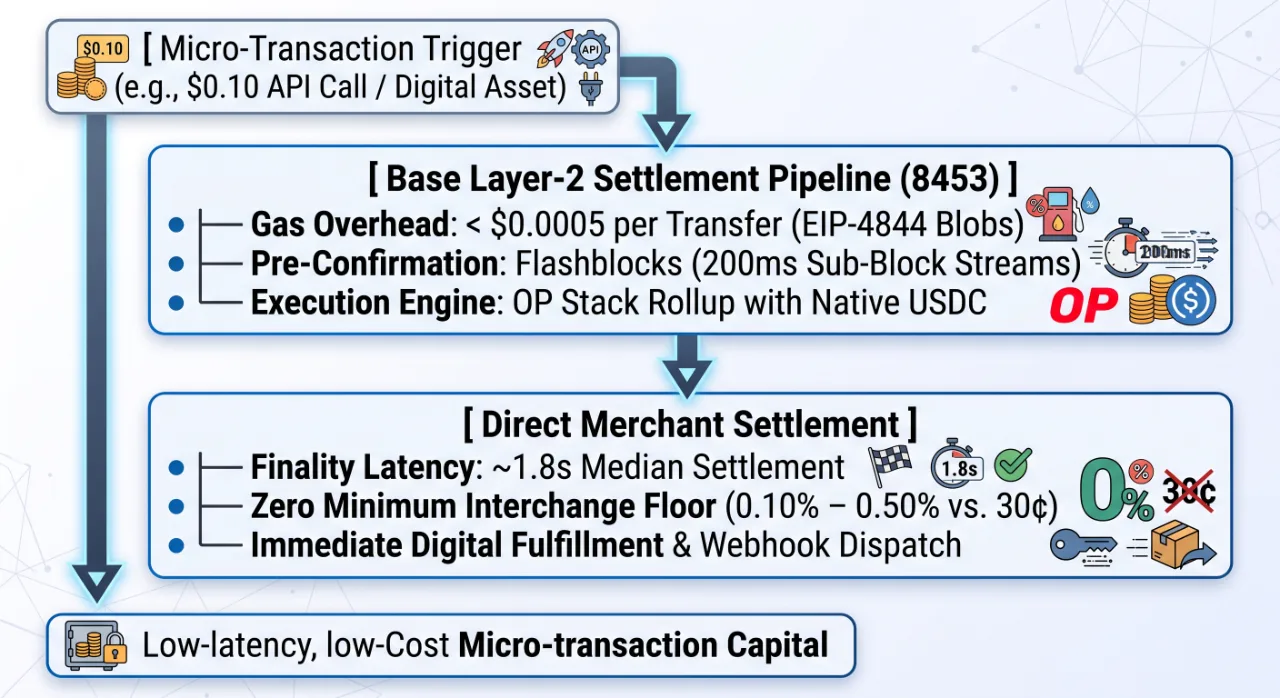
Next-generation payment architectures resolve this by anchoring settlement to Base L2 (Chain ID 8453), combining blob space data availability with sequencer-level sub-second finality.
The micro-settlement engine relies on three core technical pillars:
1. Sub-Cent Gas Economics (< $0.0005 per Settlement):
By settling transactions on Base Layer-2, execution costs drop orders of magnitude below Ethereum L1. Data posted via Layer-2 blob spaces decouples state storage costs from execution fees, enabling stablecoin token transfers that cost fractions of a single cent. This eliminates the flat $0.30 payment gateway tax, allowing merchants to price services down to $0.01 profitably.
2. Sub-Second UX via Flashblocks Pre-Confirmations:Traditional card authorizations take 2–4 seconds to handshake, while legacy blockchains take tens of seconds to reach probabilistic finality. Base utilizes Flashblocks—streaming partial block commitments every 200 milliseconds directly from the sequencer. A payment gateway listening to Flashblock event streams achieves a median settlement feedback of ~1.8 seconds in testing environments, enabling webhooks to fire and digital access to unlock instantly.
3. Native Layer-2 Dollar Rails (Base USDC):
Rather than wrapping volatile assets or routing through illiquid bridge pools, high-throughput micro-settlements execute natively in Base USDC. This delivers institutional liquidity, instant 1:1 redemption guarantees, and zero foreign exchange conversion slippage for international sellers.
By building on low-latency Layer-2 rollup rails, modern checkout systems unlock sub-dollar digital commerce that legacy financial networks cannot serve.