In Web2 development, provisioning access to an external system typically involves generating an API key. Historically, these keys default to having no expiration date. A developer creates a token, embeds it into an environment file, and promptly forgets about it. While static keys are problematic for reading data, issuing infinite-duration cryptographic signing keys to autonomous AI agents capable of moving real financial assets is a catastrophic security failure waiting to happen.
If an AI agent operates using a session key with no expiration, that key remains a permanent vulnerability long after the agent has been decommissioned or the project has been archived. A forgotten, unrestricted agent wallet is the digital equivalent of leaving a loaded company credit card on an abandoned desk.
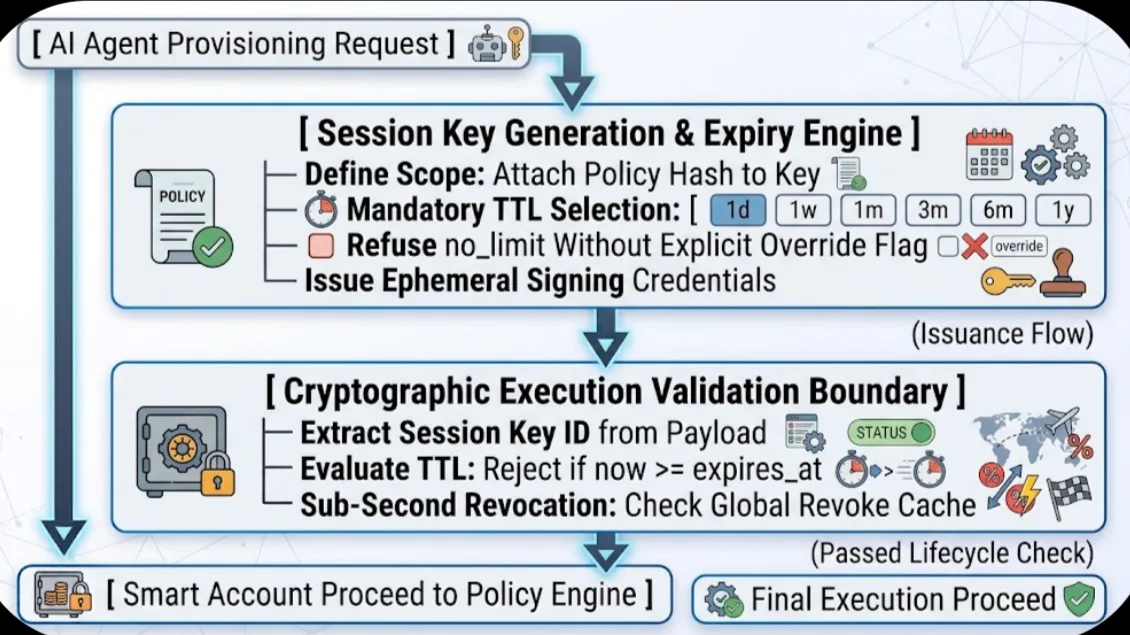
To eliminate stale authorization risk, zero-trust infrastructure enforces a Strict Lifecycle State Machine and Mandatory Ephemeral TTLs (Time-To-Live) for every generated session key.
A robust session key lifecycle operates across three strict administrative boundaries:
Mandatory Finite Expiries (7-Tier Enforcement):
1.The protocol mandates that every session key must have a precise, immutable expiration timestamp upon creation. Available tiers range from 1d (24 hours) up to 1y (365 days), with 1m (30 days) serving as the recommended default. A session cannot silently run forever. If an operator attempts to issue a permanent nolimit key, the system rejects the request outright unless accompanied by an explicit, audited security override flag acknowledging the permanent risk liability.
2.Deterministic State Machine Enforcement:
Session keys transition through a rigid state lifecycle: ACTIVE, SUSPENDED, EXPIRED, and REVOKED. The execution boundary verifies this state synchronously before any transaction payload is evaluated by the broader policy engine. If the now timestamp breaches the expiresat threshold, the key transitions to EXPIRED automatically. An expired key cannot authorize a transaction under any circumstances.
3.Sub-Second Revocation Circuit:
While TTLs handle gradual expiration, a compromised agent requires immediate neutralization. The system implements a rapid revocation mechanism that instantly alters the key state to REVOKED. This revocation cache sits ahead of the on-chain submission phase, ensuring that compromised ephemeral keys are permanently neutralized in sub-second timeframes, completely preserving the master treasury balance.
By binding autonomous execution to ephemeral lifecycles, organizations guarantee that abandoned agents naturally lose their financial capability, removing the burden of manual key rotations and closing the door on stale authorization exploits.