In conventional access control architectures, whitelisting destination addresses is often treated as sufficient security. If an autonomous agent or automated script needs to interact with a merchant or service, systems allowlist that specific contract address and permit outbound transactions.
However, in an on-chain execution environment, an address whitelist alone is merely an open door with a trusted name on it.
Many modern smart contracts—including routers, upgradeable proxies, multi-purpose merchant contracts, and liquidity pools—expose multiple state-changing methods. A contract may host a benign payment function alongside administrative functions, generic batch-execution handlers (execute()), or token-swapping routes. If an autonomous AI agent is granted unrestricted access to a contract address, an adversary leveraging prompt injection or an unhandled logic loop can trick the agent into invoking arbitrary methods on that contract, resulting in unauthorized allowance approvals or state drains.
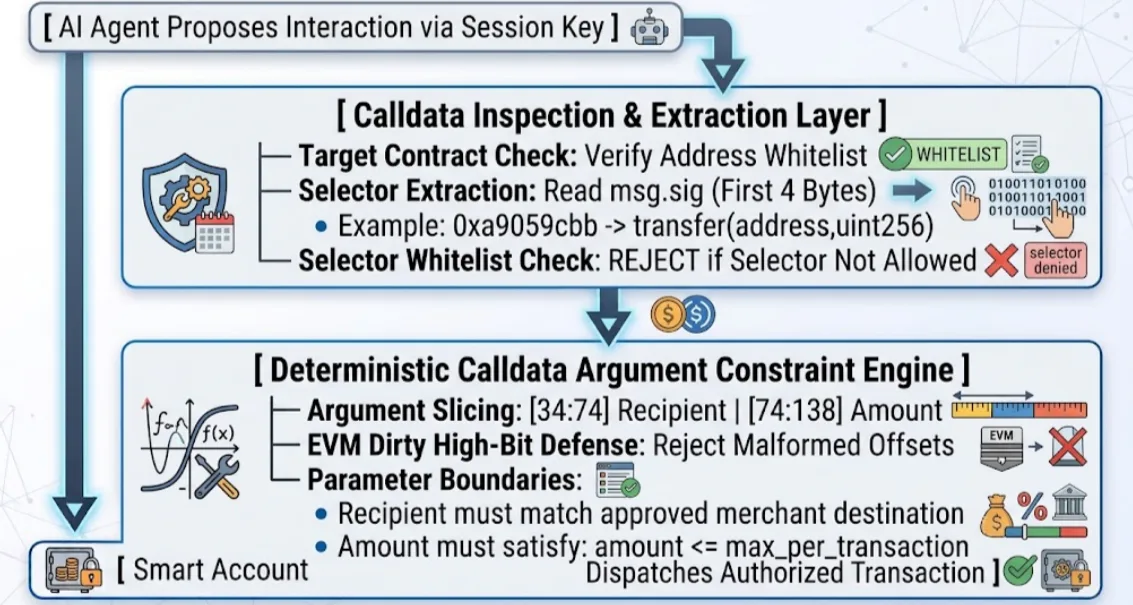
To establish true zero-trust execution, payment rails must enforce 4-Byte Function Selector Whitelisting and Granular Calldata Parsing at the execution boundary.
Enforcing execution controls beyond raw destination addresses relies on three core mechanisms:
Deterministic 4-Byte Selector Verification:
Every EVM transaction calldata payload begins with a 4-byte function identifier derived from the keccak-256 hash of its signature. The policy engine extracts these first 4 bytes (msg.sig). If an agent attempts to call approve(address,uint256) (0x095ea7b3) or transferFrom(address,address,uint256) (0x23b872dd) on a contract where only direct transfer(address,uint256) (0xa9059cbb) is authorized, the transaction reverts before reaching the mempool.
Argument Decoding & Calldata Bounds:
Whitelisting a function selector without inspecting parameters leaves the account vulnerable to arbitrary values. The validation layer decodes the calldata arguments:
TypeScript
// Extract recipient address and transaction amount
const extractedRecipient = '0x' + calldata.slice(34, 74).toLowerCase();
const rawAmountBigInt = BigInt('0x' + calldata.slice(74, 138));
The engine verifies that the recipient matches an approved address set and that the transfer value strictly conforms to the active policy envelope.
Defense Against Dirty High-Bit Manipulation:
In standard EVM ABI encoding, a 20-byte address occupies a 32-byte word, padded with 12 zero-bytes. Attackers can intentionally populate these leading bits with garbage data. Strict calldata validation verifies that padding bits are clean, neutralizing decoding ambiguities before the transaction is executed.
Restricting autonomous agents to explicit function selectors and validated parameter bounds guarantees that pre-approved contracts can never be weaponized against your treasury.